
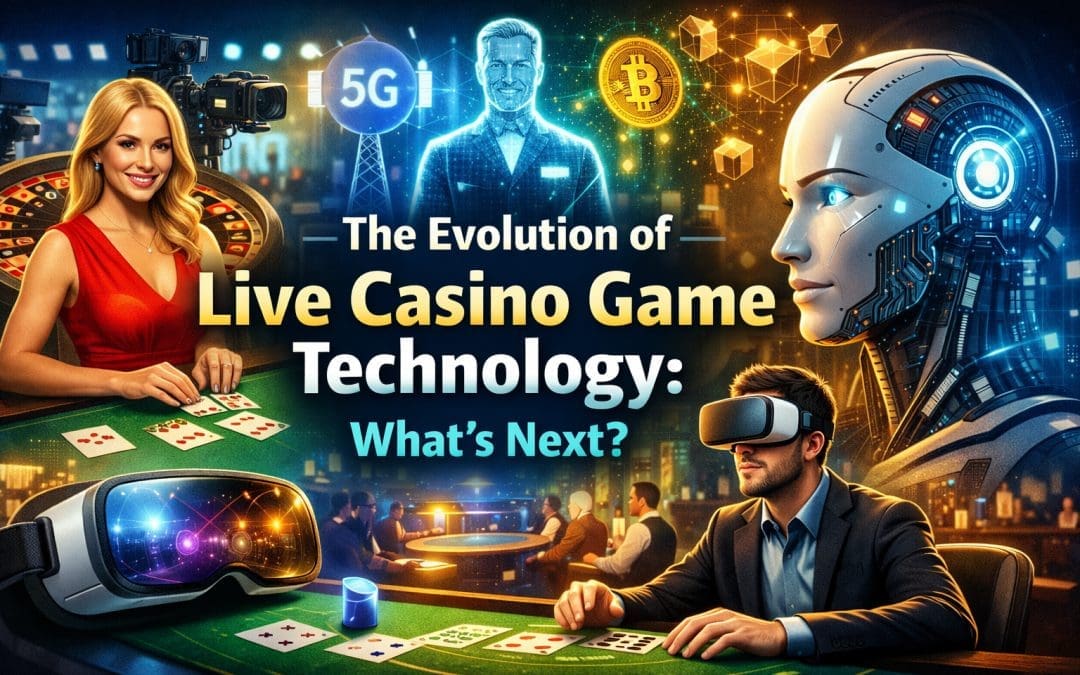
When you walk into a casino, the sounds, pace, and choreographed interactions among dealers and players are palpable. For many years, online casinos have tried to create a comparable atmosphere. There’s been no shortage of effort, but until recently, the success was lacking. That all changed with the emergence of live dealer studios, which have revolutionized how people gamble digitally.
The advancement of live casino has happened rapidly, chaotically, and surprisingly technically. What began as grainy webcam blackjack broadcasts has evolved into ultra-HD 8K broadcasts, multi-angle camera broadcasts, and interactive chat capabilities that surpass those of Twitch in terms of responsiveness. I’ve watched live casino studios evolve their equipment, update their streaming infrastructure, and experiment with live dealers, motion capture dealers, and blockchain live casinos over the past ten years. And we’re far from being done.
From Studio Streams to Immersive Worlds
At one time, the first generation of live casinos appeared like security feeds from the corner of a room. Cameras were static, lighting was harsh, and the only buffering that occurred was due to poor internet connections. If you gambled during peak hours, you expected a few seconds of delay between the moment you made your wager and the moment the cards landed.
In those days, streaming with low latency was more of an aspiration than a guarantee.
HD Live Dealers Emerged
Around the early 2010s, providers like Evolution Gaming, Playtech, and NetEnt Live treated live tables as they would a television show rather than a simple webcam broadcast. These providers set up studios that included professional lighting, custom-made roulette wheels, and trained presenters who understood the importance of timing and interacting with players by name.
You could clearly tell the difference. Cards were sharp. The felt on the table had texture. Presenters were able to engage with players through usernames, creating a tangible (albeit subtle) sense of participation.
The emergence of Optical Character Recognition (OCR) card reading was the turning point. Instead of requiring a person to enter the outcome of each round into backend systems, OCR read the cards and roulette results as they were dealt. This allowed players to receive instant confirmation of the outcome of their bets and provided real-time tracking of bets, eliminating human error and decreasing the number of disputes regarding the outcome of a bet. Moreover, the use of automated systems for logging the outcome of each round virtually eliminated the number of disputes that occur when a system automatically logs the outcome of a card at the exact millisecond it is dealt.
Localized studios offered by companies like Pragmatic Play Live and Authentic Gaming took things to the next level by exploring various regional studios. Localized studios featured different languages, regional hosts, and culturally specific presentation styles. The overall experience began to resemble participating in a large-scale, global community of casino floors, rather than simply viewing a remote table.
The Effect of 5G on Latency
Streaming has always been the cornerstone of live casinos. While 800 milliseconds versus 150 milliseconds may not be significant to a platform like Netflix, the difference can have a substantial impact on the experience of a live casino player attempting to place a last-minute roulette bet.
5G live gaming has fundamentally altered expectations regarding what is possible in terms of low latency. With the advent of 5G infrastructure and its ability to provide significantly lower latency and greater bandwidth, live casino operators quickly adapted to take advantage of the new opportunities.
Suddenly, mobile-first live casino interfaces were no longer a compromise. You could ride a train, access a baccarat table via your phone, and experience a form of real-time interaction.
While latency impacts the trust factor of live casino gaming, it also affects trust. When players see cards being dealt nearly instantaneously after clicking “bet,” it enhances trust. The psychological divide between digital and physical gaming begins to narrow.
Although 5G is not yet universally available, many rural locations still utilize 4G connectivity or spotty service, resulting in inconsistent experiences. To mitigate this, live casino operators have developed adaptive streaming systems that decrease video quality when necessary while maintaining the stability of live casino gameplay.
It’s a delicate balancing act. None of us want to experience delays or buffering at the precise moment when a dealer discloses whether he or she has received a blackjack.
Current Technology Used in Live Casinos
When you pull back the curtain on a modern live casino studio, you’ll discover something much more akin to a television production studio than a traditional casino.
Multiple cameras. Soundproof rooms. Network engineers focused on minimizing packet loss in real-time.
Multi-Camera OCR Systems
Today’s next-generation live-dealer games utilize multiple-angle camera systems to display live-action gaming. A single blackjack table may have five or six cameras: overhead, side-angle, dealer-closeup, chip-tray, and a wide-angle shot to provide ambiance.
This provides multiple benefits:
Transparency: Players can visually confirm every action taken during the game.
Flexibility: Depending on the platform, players may be able to switch between different camera angles or have the platform automatically transition to different views depending upon what happens during the game.
Marketing: Slick camera transitions during a big roulette spin increase player engagement.
Modern OCR card recognition systems complement multi-camera systems. Even if one camera angle is obstructed, the others will verify the outcome of the game. Redundancy helps eliminate errors and meet regulatory requirements for live casino gaming in jurisdictions that require such redundancy.
Studios owned and operated by Ezugi, OnAir Entertainment, and Extreme Live Gaming have developed these systems to the point where dealers typically do not interact directly with the technology.
Systems now exist that help dealers perform tasks more efficiently and accurately. AI-driven dealer assistance is a growing trend in the industry.
Flagging Suspicious Betting Patterns
Auto-Moderating Chat
Alerting Supervisors When a Dealer Does Not Follow Established Procedures
I have observed systems that remind dealers to complete missing steps, such as offering insurance in blackjack. These reminders appear on the dealer’s private monitor and are invisible to players. Reduced training time and increased consistency in gameplay are two key benefits.
Platforms also provide backend personalization. Recommendation engines analyze player behavior to suggest smart game recommendations. If a player consistently plays low-stakes roulette during non-peak hours, the system may recommend a quieter table with similar pacing.
Personalization in gaming is not unlike personalization in entertainment platforms. The difference lies in the potential for over-personalization to cross a threshold and intrude upon the player experience.
Gamblers do not desire to be profiled. Gamblers want convenience and not surveillance.
The Next Frontier: Virtual Reality and Augmented Reality Live Casino Experiences
The next wave of innovation in live casinos involves the intersection of virtual reality (VR) and augmented reality (AR). Both of these technologies represent the evolving frontiers of live casinos.
Virtual Reality Casino Floors
Recently, I experimented with an early prototype of VR live casino experience utilizing a Meta Quest VR headset. Rather than watch a 2-D video broadcast, I found myself standing in a rendered casino floor environment. The tables were located in a virtual area and I could “walk” to the blackjack table.
The dealer remained a real human being, but the experience differed due to the spatial context. I could turn my head to the left and see other avatars. Turn to the right and I could see a roulette wheel spinning in the distance.
The technology is not flawless. The resolution of VR content is generally inferior to traditional displays. Some players experience motion sickness. Additionally, the install base of VR headsets is currently relatively small compared to mobile phones.
However, the direction is obvious. As the performance of VR hardware continues to improve and platforms such as NVIDIA Omniverse facilitate more robust and detailed shared virtual environments, VR live casino environments will be viewed as more than just demonstrations of emerging technology.
The true breakthrough will occur when social multiplayer tables in VR live casinos become seamless. Avatars will be able to communicate via voice chat. Motion-capture dealers will track gestures performed by avatars. Interactive gamification elements will be accessible and available throughout the space.
Augmented Reality Overlays
AR live casino streaming may be more viable in the short term. Consider overlays projected onto the live feed from your smartphone or tablet.
Visualize watching a live baccarat game and having probability trends, real-time bet tracking, and personalized statistics float above the table. Not cluttered. Not overwhelming. Enough to inform decision making.
Several early-stage live casino providers are testing AR overlays to provide players with the ability to project holographic versions of casino tables onto their coffee tables at home. The dealer remains visible on-screen, but the chips and betting locations are displayed in 3D.
Niche. Yet, it indicates where immersive casino experiences are headed. Blending layers of physical and digital gaming instead of substituting one for the other.
AI-Driven Dealer Assistance and Personalization Trends
Predictions about the future of live casino technology are common. More intriguing trends are developing beneath the radar of personalization engines.
Smart Game Recommendations
Recommendation engines used in live casinos function similarly to those in streaming platforms. Recommendation engines examine session length, preferred game type(s), betting range(s), and time-of-day patterns.
Here’s where it becomes nuanced. In gaming, responsible gaming is important. Recommendation engines cannot simply push higher-stake tables because a player had a single successful session. Regulators scrutinize these systems.
More intelligent platforms focus on connecting players with environments that best match their habits. For instance, if a player prefers playing on social multiplayer tables with active chat, the recommendation engine may identify those options first. Conversely, if a player disables chat and completes rounds quickly, the recommendation engine may present quieter tables.
Machine Learning Models
The primary technology used to develop recommendation engines is machine learning models trained on anonymous data sets. The primary objective is to eliminate unnecessary complexity and maximize player convenience.
Adaptive Table Dynamics
Another trend that is being explored in live casino innovation discussions for 2026 is adaptive table dynamics. Features that illustrate personalized game speed and dynamic camera views based on player preferences include examples.
Envision playing roulette and experiencing a shorter spin interval during low traffic hours to encourage player engagement without feeling hurried. Envision playing blackjack and experiencing a faster idle period when all players have completed their actions.
Adaptive table dynamics will create smoother flow in gaming. The adjustments are so minor that most players will not even realize they are occurring; however, they will feel the difference in pacing.
Additionally, some providers are experimenting with motion-capture dealers for hybrid games. Hybrid games use a combination of live and computer-generated components. In these games, a live dealer’s movements are captured using motion-capture technology and are then mapped onto stylized digital avatars. The end result is a mix of the authenticity associated with live gaming and the visual appeal of game-show style formats.
Blockchain and Security Enhancements
Trust is the primary commodity of online gaming. Without trust, the entire system collapses.
Provably Fair Live Results
Blockchain live casinos aim to address trust issues head-on. Provably fair live games, which allow players to verify that outcomes were not altered after bets were placed, are common in traditional online slots.
Applying this principle to live dealer gaming is more complicated, since live dealer outcomes are produced physically. Nevertheless, some platforms are now recording live-game events onto blockchain ledgers. Such ledgers create tamper-evident records of bets, results, and payouts.
This does not replace regulatory oversight. It supplements it.
Players who are interested in transparency can verify the timestamp and outcome hash of their bets. The vast majority of casual players will not delve into the details of such records; however, the fact that the option exists lends credibility to the operator.
Crypto Instant Settlements
Use of cryptocurrency to facilitate payments in live casinos has evolved from novelty to mainstream. Several live casino operators now accept near-instant deposits and withdrawals using stablecoins and popular cryptocurrencies.
Advantages of crypto instant settlements include faster processing times and reduced transaction costs, particularly in regions where traditional banking infrastructure is unreliable. Instant settlements via crypto also shorten the waiting period for cashouts from days to minutes.
Disadvantages include volatility that complicates bankroll management, and varying degrees of regulatory clarity across jurisdictions. Therefore, operators must adhere to strict geolocation verification and compliance procedures to ensure that they comply with local regulations.
Despite the limitations, both crypto and blockchain technologies are creating permanent niches in the live casino ecosystem.
Mobile First and Cross-Platform Designs

Most live casino sessions begin on mobile devices. As a direct result, live casino operators like BetGames, VIVO Gaming, and MediaLive Casino have prioritized mobile-first live casino design.
Mobile-first design is not simply downsizing a desktop design. It demands a completely new approach to interaction. Button placement should be easily accessed with thumbs. Bet sliders should respond immediately. Chat windows should collapse smoothly without obscuring the table view.
Additional complexities arise when considering cross-platform live play. A player may initiate a live casino session on their laptop at home, transition to a mobile device while commuting, and then seamlessly resume their session.
Therefore, session persistence and simultaneous real-time tracking of bets are critical.
Ultra-HD 8K streams look impressive in promotional materials. However, they must scale down effectively for mobile devices with limited bandwidth. Adaptive bitrate streaming has become a normative practice in the industry to ensure a smooth experience regardless of network conditions.
Emerging Trends in Live Casino Technology – 2026 and Beyond
As we think about the emerging trends in live casino innovation 2026, we hear some common phrases from the live casino space: More Immersive Experiences, Tighter Integration Between Virtual and Physical Spaces, More Autonomy for Players.
Live Dealer Holographs and Integration with the Metaverse
There have been early prototype tests of holographic tables that sound like science fiction right now. However, the ability to see a live dealer in 3D (like you would at a brick-and-mortar) has potential.
At present, this type of experience is both costly and experimental. At least, so far, the hardware needed is not mainstream. As display technology continues to evolve and become more affordable, the concept of having a holographic image of a live dealer appear in your living room will not seem so outlandish.
Another area of development that is being explored is metaverse style integration. This is a shared virtual environment where you can find live casino gaming tables, social hubs, branded experiences, and tournament opportunities. Gaming platforms are currently testing how to integrate real money live games into their larger digital ecosystem.
The biggest challenge will likely be ensuring that all aspects of the platform are compliant with regulatory requirements. In the U.S., for example, there are many restrictions associated with real money gaming. Integrating gaming with open virtual worlds requires thoughtful design.
Based on what is happening today, if I had to put my money on which five live casino technologies will be the most practical and viable in the next year or two, I would choose:
1. Widespread adoption of VR live casino rooms once the cost of headsets comes down.
2. Advances in AI live dealer tech that can provide real time fraud detection capabilities.
3. More widespread availability of provably fair live games supported through blockchain logging.
4. Multi-angle camera stream enhancements that allow players to view the table from various angles via a mouse click or swipe.
5. Seamless cross-platform live casino play capabilities that use one wallet across multiple platforms.
Not all experiments will be successful. There may be pilots that fail quietly. However, the trend is becoming clear: more immersive, more transparent and more flexible.
Ultimately, The People Are The Focus Of Live Casinos
Regardless of how much technology we incorporate into live casinos — including AI, VR and blockchain — live casinos remain fundamentally about people. A charismatic dealer can make an otherwise ordinary blackjack game memorable. A responsive host can help calm a frustrated player during a technical issue.
While technology can enhance those moments, it cannot replace the human element.
I’ve seen the evolution from a basic HD setup to a full-scale production studio with live social multiplayer tables and game-changing elements displayed in real-time on the screens. Often times, the players who return regularly cite the same reason: They feel like they matter.
Going forward, we expect live casino tech to continue to push the boundaries of what is possible. We expect even sharper streams, more intelligent interfaces and more immersive casino experiences. However, the fundamental equation for creating a compelling live casino experience remains deceptively simple. Combine good streaming quality, fair results and authentic human interaction.
All other elements are merely refinements.